New Discovery Lets You Finally Break Free From Chronic Pain Without Drugs, Surgery or Other Invasive Treatments
Even When You've Tried Everything Else

Chronic pain is a lonely and frustrating experience.
You keep searching for answers. You keep trying new treatments. Hoping this one will finally work. But nothing seems to last.
And the pain just keeps coming back.
So you try to stay strong. You smile on the outside, but inside, you’re worn out. You lose hope with every treatment that fails. Wondering if this will ever end.
Worse still, it feels like no one understands what you’re going through. So you suffer in silence, while your life gets smaller and smaller.
And then you might be told your only option is surgery. Or that there are no options left to try. And you just have to learn to live with the pain.
If any of this sounds familiar.
If you feel like you’re a prisoner of pain, living on the sidelines of life.
You’re worn out and running out of hope...
And you suffer from:
- Back Pain
- Joint Pain
- Fibromyalgia
- Sciatica
- Neck Pain
- Foot Pain
- Repetitive Strain Injury
- Pelvic Pain
- Tendonitis
- TMJ Pain
- Stomach Pain
- Unexplained/Unspecific Pain
- and many other types of chronic pain...
New evidence shows you could be pain free, without drugs, surgery, or other invasive treatments.
Ground-breaking new research provides some of the strongest evidence yet that a non-drug, non-surgical approach can provide potent and lasting relief from chronic pain.
In a recent study, 66% of people who engaged in a new approach combining neuroscience with gentle, strategic movement were either pain-free or nearly pain-free by the end of the study.
And stayed that way after a year:
Pain Reduction vs Placebo Over 12 Months
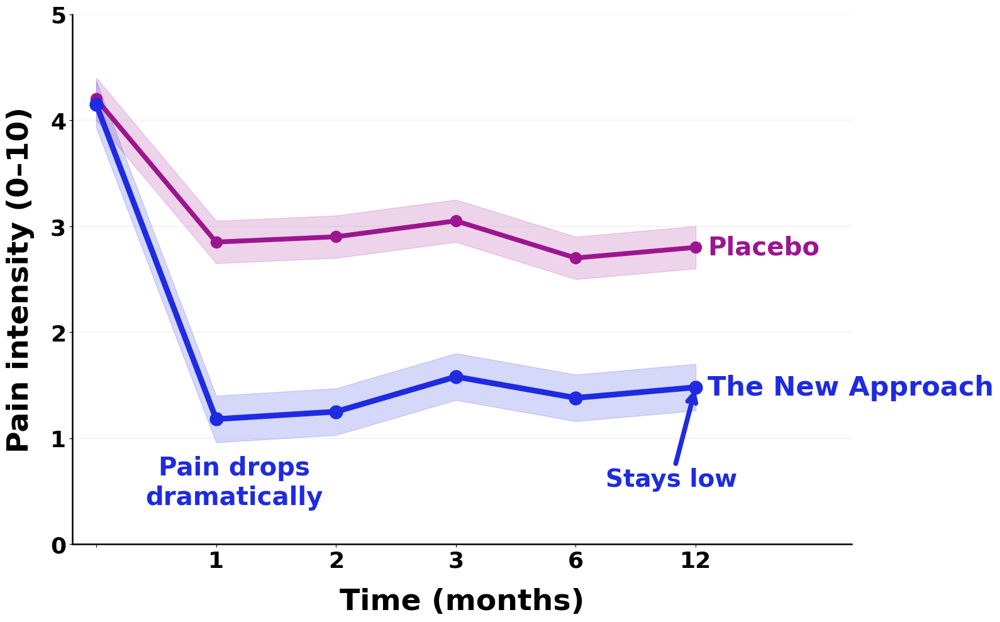
Source: Ashar YK et al. (2022) Figure 2. Clinical Outcomes
As you can see, the new approach clearly beat the placebo treatment. And after 12 months, the pain stayed low or vanished completely.
Another follow up was done after 5 years. The Pain STILL hadn't come back:
Pain Reduction After 5 Years
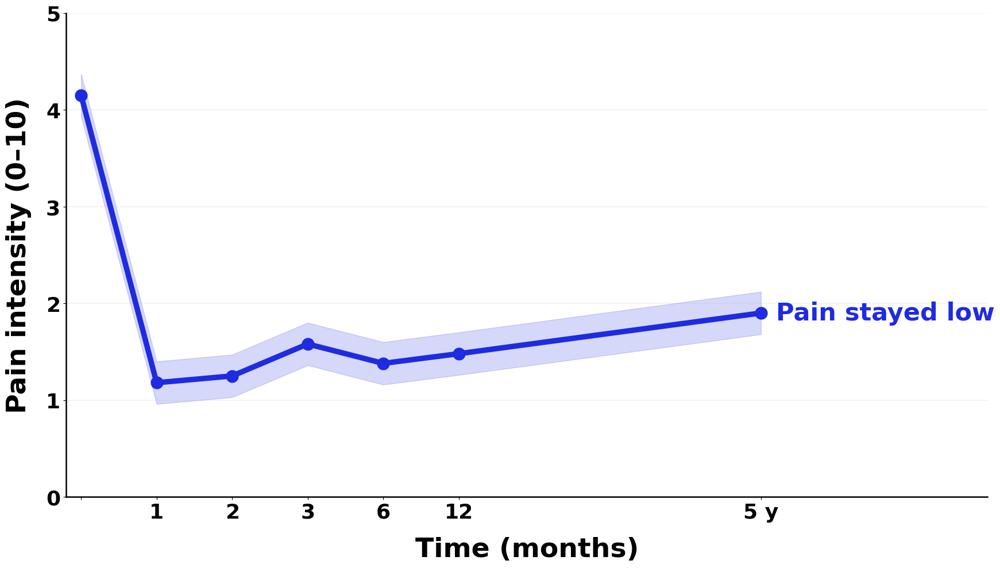
Source: Ashar YK et al. (2025) Figure A. Pain Intensity Through 5-Year Follow-Up
Keep in mind these are average pain levels across the whole group. Most of the group stayed pain-free or almost pain-free.
These outcomes are unprecedented and mark a turning point in chronic pain recovery.
Most people with chronic pain feel like they’ve tried everything and run out of options. Even doctors are scratching their heads, wondering what to do with all their pain patients.
As you may know, there are lots of different types of treatment for chronic pain; things like opioids, massage, chiropractic, osteopathy, acupuncture, physical therapy, and many others.
You may have even tried all of these options already. If not, it’s only a matter of time before you work your way through the list. People with pain will try anything to find relief.
Unfortunately, the long-term effectiveness of these approaches has been disproved in large, well conducted scientific studies.
*You can find these studies at the bottom of this page
These treatments might give you some relief, for a short period of time. Yet, there’s no scientific proof they work better than a placebo. Even most surgeries are no better than placebo, and can actually make things worse.
It’s why chronic pain continues to affect over a billion people worldwide, without any sign of easing. It’s why even doctors are throwing up their arms in frustration, heartbroken each time they spot you in their waiting room.
And it’s why this recent study is so ground-breaking. It scientifically demonstrated that something, anything, can provide potent and lasting relief from chronic pain.
What’s more, this new approach puts you back in the driver's seat, and can be done from the comfort of your home. No more painful travel, frustrating waiting rooms, or scheduling conflicts.
15 minutes on most days is all you need to get started.
Our FREE downloadable book The Missing Link provides all the information you need to find out if this approach is right for you:
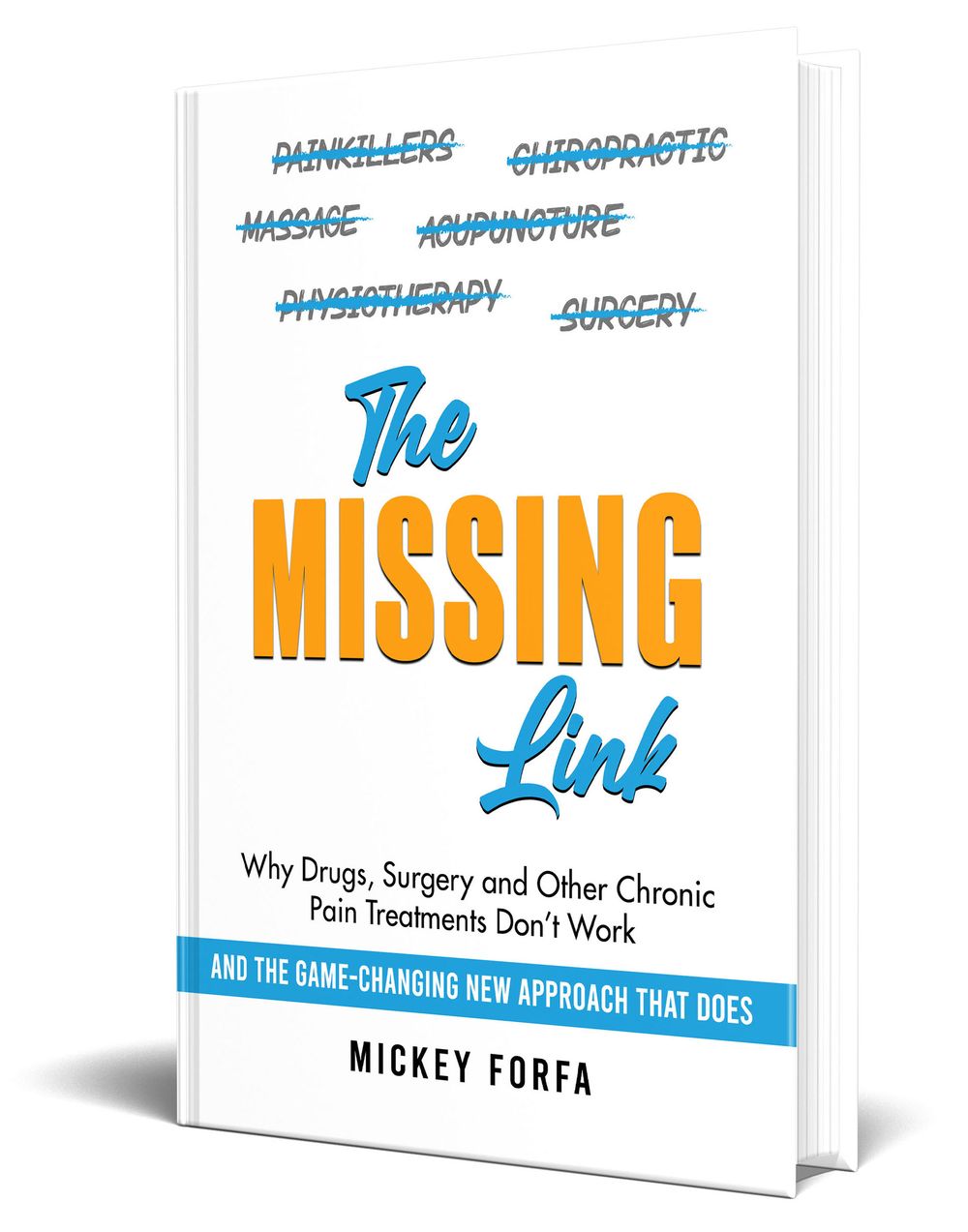
Foreword by Dr Adele Stewart, MD
(Chair RACGP Pain Management Specific Interest Group)
This free, downloadable book also includes self-assessments, exercises, and example therapy sessions.
It was developed to help you decide if this approach is right for you. And if it is The Missing Link will help you explore the options available to you, to resolve your chronic pain for good.
We’re giving away this book for free because everyone who needs this information should have it.
Also, if you find this approach is right for you, you might choose to work with us moving forward. Our hope is this book will answer all your questions and give you much needed clarity.
So, here’s what to do next:
Simply add your details in the form below. As soon as you do, a digital copy of the book will be sent to your email address.
In a few days we’ll reach out by phone to discuss your pain, what you've already tried and whether our flagship program PainRetrain could be a good fit.
We'll explain how the program works, answer your questions and help you decide whether you'd like to get started with the risk-free 14-day trial.
You don't need to read the book or watch the videos beforehand. We'll cover everything you need to make an informed decision during our conversation.
Please note: This call is intended solely for informational purposes and does not constitute a diagnostic consultation. If you're left with any uncertainties after our conversation, we strongly recommend discussing your condition further with your primary healthcare provider.
Foreword by Dr Adele Stewart, MD
(Chair RACGP Pain Management Specific Interest Group)
Here’s what you’ll discover when you get your FREE digital copy of The Missing Link…
- You’ll get a firsthand glimpse of the approach used in this groundbreaking study
- You’ll see why and how it works
- You’ll learn the real cause of most forms of chronic pain
- You’ll understand why pain killers, surgeries and conventional treatments fall short in the long run
- You'll learn if this approach is right for you
- And much more…
Sources:
1. Effect of Pain Reprocessing Therapy vs Placebo and Usual Care for Patients With Chronic Back Pain: A Randomized Clinical Trial. Ashar YK et al. (2022) JAMA Psychiatry
In this ground-breaking, placebo controlled scientific study 66% of participants – who had chronic pain for an average of 10 years – were either completely pain free or almost pain free (pain level of 1/10) after the study. Without drugs, surgery or other invasive or expensive treatments.
2. Psychophysiologic symptom relief therapy for chronic back pain: a pilot randomized controlled trial. Donnino, Michael et al. (2021) PAIN Reports
This is another similar yet smaller study where 63.6% reported being pain free (pain of 0/10) after engaging in a similar approach, compared to a placebo.
3. Pain Reprocessing Therapy vs Placebo and Usual Care for Patients With Chronic Back Pain 5-Year Follow-Up of a Randomized Clinical Trial. Ashar YK et al. (2025) JAMA Psychiatry
In this study the researchers followed up with the participants of the original study. They discovered that most people maintained their pain relief after 5 years. This is simply unprecedented.
4. Massage for low-back pain. Furlan et al. (2015) Cochrane Database Syst Rev.
This study shows that things like massage and trigger point therapy show short-term relief, at best. But very little change in long-term pain outcomes.
5. Exercise interventions for chronic low back pain. Searle et al. (2015) Clin Rehabil; Exercise therapy for chronic low back pain. Hayden et al. (2005) Ann Intern Med.
These two studies show that the same is true for most forms of physical therapy. Again and again, the evidence shows that these things rarely produce lasting change in chronic pain.
6. Effectiveness of dry needling for musculoskeletal pain. Gattie et al. (2021) Phys Ther; Injection therapy for subacute and chronic low-back pain. Staal et al. (2008) Cochrane Database Syst Rev.
These studies show that injections, dry needling, and things like kinesio taping show the same pattern: short- term relief, minimal long-term benefit.
7. Spinal manipulative therapy [Chiropractic] for chronic low back pain. Rubinstein et al. (2019) Cochrane Database Syst Rev.
Spinal manipulation, used by chiropractors, has been studied extensively. This large meta-analysis (the strongest kind of evidence we have) found only modest short-term improvements in pain and function, with no better results than exercise or medical care. Even more concerning, over half of the studies reported side effects, including increased pain, worsened disability, and in rare cases, serious complications.
8. Traction [Spinal Decompression] for low-back pain with or without sciatica. Wegner et al. (2013) Cochrane Database Syst Rev.
This was a large review examining 32 studies involving 2,762 people. It found that spinal traction (the same mechanism used by spinal decompression beds) provided little or no improvement in pain or function compared to placebo or other treatments. Even people with sciatica showed little or no benefit. More expensive, computer-controlled decompression beds have also failed to demonstrate a convincing advantage over conventional traction. More concerningly, some studies reported increased pain, worsening neurological symptoms, and even patients subsequently requiring surgery.
Please note that PainRetrain does not provide medical advice and its services are not intended to be a substitute for advice from your doctor or other medical professionals. No conclusion about your health should be drawn from any information provided by PainRetrain. If you have concerns, discuss them with your doctor or other medical professionals. All content is for general informational purposes only.
PainRetrain - All Rights Reserved
Use of www.painretrain.com is subject to our terms of service and privacy policy